Thursday, February 25, 2010

Reflection Paper No. 3


Emily Rice
February 25, 2010
Religion 124-08

Jesus nationality is something that most European Christians like to forget. Jesus was a Jew living in Galilee, which is made clear through the Gospels when we take into consideration that Jesus celebrated Passover, and had a message that was directed mainly at the Jewish community. Barbara Reid in her analysis of Matthew (The Gospel According to Matthew) points this out in one very simple paragraph. “He is a thoroughly observant Jew who is devoted to keeping the Law. He does not replace the Law, nor does he break it; rather, he fulfills it, bringing it to its intended purpose. He is authentic interpreter of the Law for a changed situation“(36). The verses (Matthew 5:17-20) make his intentions clear, and the interpretations in the following verses do not stretch the mind unreasonably. Jesus teaches that anger is on the same level as murder, and that to be angry at your brother is an equivalent sin to killing your brother. In the same interpreting style, he teaches that lustful looks are measured on the same vain as adultery. On the level of the Jewish law, these are not unreasonable. Laws are the lowest acceptable moral measure, so the simple laws of “You shall not kill” and “You shall not commit adultery,’ are the moral minimums required for participation in society. Jesus establishes a higher moral level. This isn’t a high stretch, only an interpretation that makes sense in the context of the time.
And this probably wasn’t the first time a prophet told the children of Israel to have higher moral standards either.
But the key to this statement is that Jesus is one of the Jews, speaking from a Jewish perspective about Jewish laws. And to the original intended audience of this message that makes sense. As we talked about in class, Christianity wasn’t always separate from Judaism, just another teaching on the laws, however as the Gospels were written and Jesus became more and more divine a wedge was driven between the two. Christianity grew into the religion of the Roman Empire, thanks to Constantine I.
And as it became a European religion the concept of Jesus’ nationality changed.
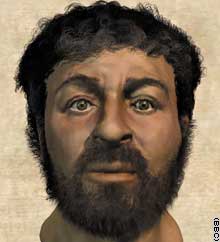
When I was a child we had a large painting in our house of Jesus, a man highlighted in a halo of light with a long brown beard, and for a long time I didn’t question the fact that Jesus was from the Middle East and therefore would not be white.
In a youth group we discussed Jesus image, but not his color. We were told that Jesus had not been a handsome fellow, so instead of a respectable man with a long brown beard I pictured a slightly rough around the edge Caucasian hippy. And this image slowly got pushed aside as I was enveloped in the typical Christian perspective of Christ. It wasn’t until high school I realized that the area Jesus lived didn’t make sense with the skin color he was portrayed with.
It’s interesting that the symbol of the Christian religion isn’t the right color to be, the savior that the Gospels were written about, and that when a more right picture is given to them, that they oppose it so forcefully.
Thursday, February 4, 2010

Response Paper 2


Response Paper 2

While reading Borg Chapter 2, two things really caught my interest; Borg’s analysis of the exorcism of Legion and his analysis of women in the first few chapters of Mark.

In the exorcism of Legion, I find it interesting that Jesus listens to the demons’ pleas to not send them out of the country, and instead sends them into a herd of pigs. That Jesus listens to the demons’ request is unusual for the son of God, in most exorcism stories Jesus just sends the demon out of the man, the miracle being to focus of the story. In this case however, Legion seems to be a greater focus than the man he is possessing. Legion takes up about two-thirds of the story, while the man who was possessed gets just one line, a line asking Jesus to let him go with Jesus and his disciples, which Jesus refuses. It is interesting that Jesus grants a demon its request, but not a man. And while the story gives the man a job to do, he continues afterwards preaching about what Jesus has done for him; but he doesn’t get the courtesy of having his request granted, this strikes me as being a strange balance.

The analysis the Borg goes into intrigues me, I like how he goes into an in depth description of the impurity of this scene. I think that Borg’s points on geography, possession, proximity to corpses, and animals make very good and reasonable points. However, I’m more confused on the direct relation with the name “Legion” to a Roman military unit. Although I understand that they share the same name I would have been less puzzled if Borg had gone into a more in depth description of why a Roman Legion is being used as a demon. Borg continues with a series of rhetorical questions that address my confusion. “Is this story about personal and political possession, and the exorcism of ‘Legion’ as the path of both personal and political liberation?” (47). But Borg doesn’t answer it. He also provides a rhetorical question on whether Jesus was on a whole attempting to rid the Jewish homeland of Roman forces, but he doesn’t answer it. I feel that it is unfair for the author to pose such questions to the reader, they may be intrigued by the concept but without an explanation he quickly loses their trust, if Borg can’t explain a concept it probably shouldn’t be introduced.


Finally, I was interested in Borg’s comments on women in the Bible. I find it interesting that he points out the important role of women in the Gospels, especially about Jesus being anointed for burial by a woman, and the women witness Jesus’ crucifixion and resurrection. Borg goes on to mention that women have a role of importance in Paul’s seven genuine letters, and that women were patrons of the Jesus movement and even apostles (49). Considering we were discussing a few weeks ago that the Pope told the 80’s women’s movement that women could not be priests because Jesus didn’t choose any female apostles, I find the proof Borg provides (Junia in Romans 16:7) to be very intriguing (49).

From what I’ve read so far, Borg seems to do a very good job of explaining and analyzing the text, my biggest complaint is the rhetorical questions he used when discussing Legion instead of providing a clearer, more interesting explanation.


Thursday, January 21, 2010

Reponse Paper No. 1


I find some of Kloppenborg’s theories interesting. On page 70 he discusses the fact that when Jesus stills the storm the disciples question, “Who is it that even the winds and seas obey him?” Kloppenborg continues, “Unknowingly paraphrasing the Psalms in which God is depicted as the one who commands the wind and sea.” Personally, I find it strange that Kloppenborg assumes that the disciples are naive enough to not know what they are saying. To my knowledge, the disciples were Jews and as Jews they would have had a rudimentary knowledge of the Torah, if this is true, the disciples would recognize their words. In our discussion in class we have spoken about the fact that the gospels were not written for at least a hundred years after Jesus’ death, that being true we can’t be sure whether these words are merely an interpretation by the author, or passed down through tradition. In writing the gospel the authors would have had to rely on either documents like Q, other firsthand narratives, or on word of mouth. In the firsthand narratives, personal judgment, opinion and personal interpretation play a large part. In a bank heist although six people could have been in the room seeing the same thing, they would tell six different stories. Word of mouth is even more precarious because stories change with each telling, an ongoing game of telephone, so that when they are written down they are drastically different than the original. In turn, a document like Q, a conglomeration of Jesus’ sayings would also have its flaws unless a scribe followed Jesus everywhere he went and wrote down his words, which is unlikely. This being the case, it is entirely possible that the authors used quotes from verses in Psalms to foreshadow Jesus’ divinity while portraying the disciples as unenlightened to that fact, as a literary device or as an interpretation of what could have happened when Jesus calmed the storm. It is possible that this is just an interpretation of the oral-scribal traditions (which Kloppenborg discusses in his Introduction) that had passed these stories down, or, a change that had occurred as the stories were passed down for a century. I find it confusing that Kloppenborg puts the disciples at fault on page 70 when so many other forces are acting upon the text. And although I realize that he is not discussing the many different sources that have affected the Bible, I still find the interpretation awkward and unmerited. He goes on to say: “If only they had listened to their own words, they would have known that Jesus must be God’s son.” But he doesn’t take into consideration the reason behind their confusion. It’s illogical to hold the fact that the disciples are naïve of Jesus’ divinity and to appear to hold it against their intelligence as Kloppenborg does, especially when, as we talked about in class, literary Jesus didn’t become completely divine until John’s gospel, more than a century after the disciples had lived. In this sense, I find the illogical assumptions that are introduced make it hard to take Kloppenborg as a scholarly writer, and easier to take his work as a man expressing his opinions of religion.


Wednesday, January 13, 2010

Assignments One and Two

Assignment #1
1. Describe Jesus in one paragraph.
Jesus is a Biblical figure portrayed in the New Testament as the son of God. According to the gospels he died on the cross so that those who believed in him could join him in heaven. He was born in Bethlehem, and performed many miracles that gave him followers, fame and the enemies that eventually led him to his death. He was betrayed by one of his disciples, Judas Iscariot for thirty pieces of silver.

2. Now describe Jesus in one sentence.
Jesus is the son of God who died for man's sins.

3. Describe Jesus in one word.
Light

4. Attach a simple image that represents that word.


Assignment #2

1. Describe yourself in one paragraph. You may focus on anything you wish, including interests, personality traits, past history, future goals.

My name is Emily Rice, I grew up in Marysville, Washington but moved to Republic, Washington my freshman year in high school. I was very involved with the school while I was in Republic. I was captain of the Debate and Knowledge Bowl teams, student assistant of the Republic Jr-Sr High school pep band, served one year as class secretary and served two years as ASB Treasurer, among other things. I am an English major with a public relations minor. I play the flute and the sousaphone/tuba and am learning to play the bass. I enjoy
acting, and have performed in more than a dozen plays including working with a group of students and adults who perform Shakespeare's comedies during the summer. I am also a member of G.U.T.S.

2. Now describe yourself in one sentence.
I am a quiet, studious person who enjoys the arts.

3. Describe yourself in one word.
Persistent

4. Attach a simple image that represents that word.